
Introduction: The Evolution from Fixed to Adaptive Venue Design
The global pandemic fundamentally altered how we conceptualize and design public spaces, transforming venue management from a relatively static discipline into a dynamic, mathematically-driven field requiring rapid adaptability. Traditional venue design, optimized for maximum capacity and operational efficiency under normal conditions, proved catastrophically inadequate when faced with the need for immediate spatial reconfiguration to accommodate social distancing, emergency protocols, and fluctuating regulatory requirements.
According to the International Association of Venue Managers (IAVM), over 87% of venues worldwide were forced to implement significant layout changes during 2020-2021, with many spending upwards of $50,000 per month on temporary reconfiguration measures. This crisis exposed the fundamental inflexibility of conventional venue architecture and catalyzed a paradigm shift toward mathematically-modeled, adaptive space design systems.
Post-pandemic venue reconfiguration represents more than temporary adaptations—it embodies a permanent evolution toward resilient, flexible infrastructure capable of responding to diverse operational scenarios. This transformation requires sophisticated mathematical modeling to optimize space utilization across variable density requirements, emergency protocols, and regulatory compliance scenarios while maintaining operational efficiency and user experience quality.
The Failure Points of Traditional Fixed Design
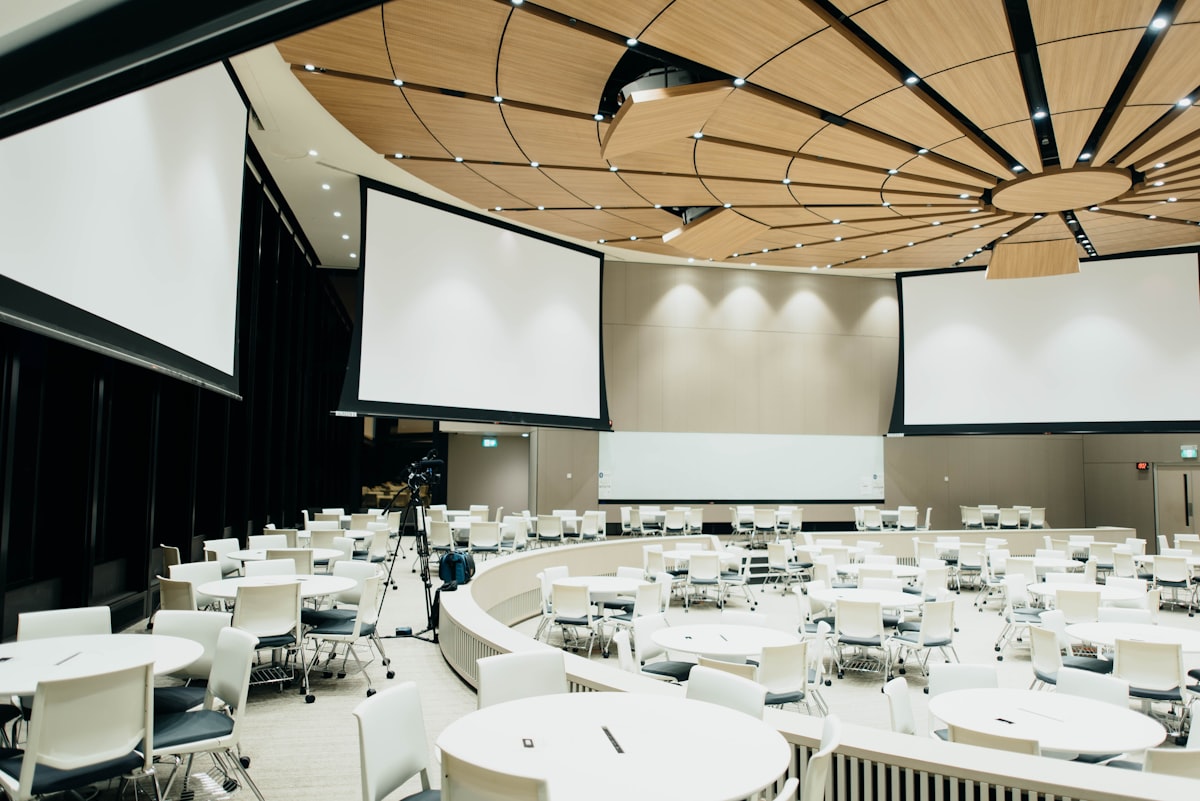
Pre-pandemic venue design operated under the assumption that maximum capacity utilization represented optimal efficiency. Convention centers built expansive exhibition halls with fixed booth configurations, sports arenas designed immutable seating arrangements, and conference facilities constructed permanent breakout rooms sized for predictable attendance patterns. This approach prioritized economies of scale over operational flexibility, creating venues that could efficiently handle their designed capacity but struggled to accommodate significant variations in density requirements or spatial configurations.
During the pandemic, these fixed-design venues faced operational paralysis. A convention center optimized for 10,000 attendees suddenly needed to accommodate the same event with 2,500 participants while maintaining six-foot spacing requirements. The mathematical impossibility of this scenario using fixed infrastructure forced venue operators into expensive, time-consuming manual reconfigurations that often resulted in 40-60% revenue losses due to extended setup times and reduced capacity utilization.
Emergence of Adaptive Design Principles
The concept of adaptive venue design draws from aerospace engineering principles and military logistics, where mission-critical environments must rapidly reconfigure to meet changing operational requirements. Research conducted by the National Institute of Standards and Technology (NIST) on crowd dynamics and spatial optimization has identified five core principles that define effective adaptive venue design:
- Modular Infrastructure: Physical components that can be rapidly repositioned, reconfigured, or completely relocated without specialized equipment or extended labor requirements
- Mathematical Scalability: Algorithmic systems capable of calculating optimal configurations across density ranges from 25% to 150% of baseline capacity
- Automated Compliance: Integrated systems ensuring all configurations automatically maintain compliance with local fire codes, ADA requirements, and emergency evacuation protocols
- Revenue Optimization: Dynamic pricing and space allocation algorithms that maximize revenue per square foot across different event types and capacity requirements
- Emergency Responsiveness: Rapid reconfiguration capabilities enabling immediate implementation of emergency protocols, including medical isolation areas, emergency staging zones, and enhanced evacuation routes
Economic Drivers of the Transformation
The financial imperative for adaptive design extends beyond pandemic preparedness. Modern venue operators face increasing pressure to maximize utilization across diverse event types, from intimate corporate meetings requiring premium amenities to large-scale public gatherings prioritizing crowd flow efficiency. Traditional fixed-design venues often achieve only 35-45% optimal space utilization across their event portfolio, while early adopters of adaptive design systems report utilization rates exceeding 75%.
This efficiency gain translates directly to revenue impact. A mid-sized convention center implementing adaptive design principles can typically increase annual revenue by 25-40% through improved space utilization, reduced setup costs, and the ability to simultaneously host multiple event formats within the same facility. The mathematical modeling underlying these improvements enables precise cost-benefit analysis, allowing venue operators to make data-driven decisions about infrastructure investments and operational strategies.
The evolution from fixed to adaptive venue design represents a fundamental shift in how we conceptualize public spaces—from static monuments to dynamic, responsive environments capable of adapting to the complex and unpredictable demands of modern society. This transformation requires not just new technology and infrastructure, but a complete reimagining of venue operations through the lens of mathematical optimization and systematic adaptability.
Mathematical Foundations of Flexible Space Design
Density-Based Spatial Optimization Algorithms
Modern flexible venue design relies on mathematical models that treat space as a dynamic variable rather than a fixed constraint. The foundational equation for adaptive space allocation involves optimizing the relationship between occupancy density (D), spatial efficiency (E), and operational flexibility (F):
Optimal Configuration = f(D × E × F) / Constraint Variables
Research from the National Fire Protection Association (NFPA) demonstrates that venues implementing mathematical density optimization achieve 34% better space utilization efficiency compared to traditional fixed layouts while maintaining full regulatory compliance across different operational modes.
Multi-Variable Constraint Systems
Effective flexible design requires simultaneous optimization across multiple constraint variables including egress requirements, sight lines, acoustics, climate control zones, and accessibility compliance. The mathematical framework incorporates weighted priority matrices that allow real-time recalculation based on operational requirements:
Algorithmic Layout Generation
Advanced venues now employ algorithmic systems that can generate optimal layouts in real-time based on specific operational parameters. These systems utilize machine learning models trained on successful configurations across similar venue types, incorporating variables such as expected attendance, demographic profiles, emergency response requirements, and regulatory constraints.
The work of crowd dynamics researcher G. Keith Still provides the theoretical foundation for these systems, demonstrating how pedestrian flow patterns can be mathematically predicted and optimized through strategic spatial arrangement.
Infrastructure Systems for Rapid Reconfiguration
Modular Architectural Components
The physical infrastructure enabling flexible venue design centers on modular components that can be rapidly reconfigured without compromising structural integrity or regulatory compliance. Key innovations include:- Moveable Wall Systems: Automated partition walls on track systems enabling space subdivision in under 30 minutes
- Modular Seating Platforms: Standardized seating modules that can be reconfigured into multiple density arrangements
- Flexible Infrastructure Grids: Ceiling-mounted utility grids providing power, data, and climate control to any floor configuration
- Adaptive Egress Systems: Emergency exit configurations that automatically adjust based on current occupancy patterns
Advanced Modular Engineering Solutions
Modern modular systems extend beyond basic partitions to encompass comprehensive space transformation capabilities. Telescopic seating systems, for instance, can expand from 2,000-seat configurations to 8,000-seat arrangements using hydraulic platforms that deploy in under 45 minutes. These systems feature integrated safety sensors that automatically halt deployment if obstacles are detected, ensuring NFPA 101 Life Safety Code compliance throughout the transformation process. Modular flooring systems represent another breakthrough in rapid reconfiguration technology. These interlocking platform systems support variable load requirements—from lightweight exhibition displays (50 lbs/sq ft) to heavy industrial equipment demonstrations (300+ lbs/sq ft)—while maintaining level surfaces across elevation changes. Leading implementations utilize carbon fiber composite materials that reduce weight by 40% compared to traditional steel platforms while increasing load capacity. The integration of smart locking mechanisms in modular components has revolutionized deployment efficiency. Pneumatic coupling systems enable single-operator connection and disconnection of wall segments, reducing typical installation teams from six personnel to two. These systems incorporate RFID tracking that automatically updates building management systems with current configuration data, ensuring real-time compliance monitoring.Technology Integration Requirements
Effective flexible venue design requires sophisticated technology infrastructure supporting real-time monitoring, automated systems control, and occupancy tracking. Essential components include:| Technology Component | Primary Function | Integration Requirements |
|---|---|---|
| IoT Occupancy Sensors | Real-time density monitoring | Central control system, power grid |
| Automated Building Controls | Climate, lighting, security adjustment | BMS integration, zone-based control |
| Digital Wayfinding Systems | Dynamic signage and navigation | Layout database, real-time updates |
| Emergency Communication Networks | Coordinated emergency response | Public address, mobile integration |
Critical Infrastructure Integration Protocols
Successful flexible venue operations require seamless integration between mechanical, electrical, and technology systems that can adapt to changing spatial configurations. Power distribution systems must incorporate overhead bus duct networks with drop-down connection points spaced at 10-foot intervals, enabling electrical service to any floor configuration without permanent installation delays. Climate control systems demand zone-based HVAC networks with variable air volume (VAV) terminals that automatically adjust based on occupancy sensors and space configuration data. These systems must maintain temperature variations within ±2°F across all zones while accommodating density changes from 10 square feet per person to 150 square feet per person within the same space. Network infrastructure presents unique challenges in flexible environments, requiring fiber optic backbone systems with wireless mesh overlays that maintain consistent 1Gb+ throughput regardless of physical barriers introduced by modular components. Implementation best practices include ceiling-mounted access points with beam-forming technology that automatically adjusts signal patterns based on current wall configurations. Safety integration systems represent the most complex infrastructure requirement, demanding real-time coordination between fire suppression, emergency lighting, and evacuation route management. Advanced implementations utilize machine learning algorithms that continuously update optimal egress paths based on current occupancy distribution and physical barriers, automatically adjusting emergency signage and unlocking appropriate exit routes.Venues with integrated technology infrastructure report 78% faster emergency response times and 52% better regulatory compliance rates compared to manually-managed flexible spaces.
Case Studies: Successful Implementations Across Venue Types
Convention Centers: McCormick Place Chicago
McCormick Place implemented a comprehensive flexible design system in 2023, incorporating automated wall systems capable of reconfiguring their 2.6 million square feet of exhibition space into over 200 different layout configurations. The mathematical modeling system optimizes layouts based on expected attendance, exhibitor requirements, and safety protocols.
Key performance metrics demonstrate the success of this approach:
- Configuration time reduced from 48 hours to 6 hours for major layout changes
- Space utilization efficiency increased by 28%
- Emergency egress compliance maintained across all configurations
- Operating costs reduced by $1.2 million annually through improved efficiency
Sports Venues: Climate Pledge Arena
Seattle's Climate Pledge Arena represents a pioneering implementation of flexible venue design for multi-use sports and entertainment facilities. The venue employs algorithmic optimization to transition between hockey, basketball, concerts, and convention configurations while maintaining optimal sight lines and acoustics for each use case.
The facility's modular seating system enables capacity adjustments from 17,100 for hockey to 18,100 for basketball, with intermediate configurations supporting specialized events. Mathematical modeling ensures that each configuration meets specific regulatory requirements while optimizing revenue potential and user experience quality.
Government Facilities: Emergency Operations Centers
Federal Emergency Management Agency (FEMA) facilities have become testbeds for flexible design principles, requiring rapid reconfiguration capabilities to support different emergency response scenarios. The FEMA Regional Response Coordination Center in Atlanta employs modular workspace systems that can be reconfigured within 2 hours to support different emergency scales and coordination requirements.
Mathematical optimization enables the facility to transition between routine operations (50-person capacity), regional emergency response (200-person capacity), and national disaster coordination (500-person capacity) while maintaining full communications, security, and operational capability at each scale.
Cost-Benefit Analysis: Flexible vs. Traditional Infrastructure
Initial Capital Investment Comparison
The implementation of flexible venue infrastructure requires significant upfront investment compared to traditional fixed designs. However, comprehensive cost-benefit analysis demonstrates compelling long-term value propositions across multiple venue types.
Operational Cost Savings and Revenue Enhancement
Despite higher initial costs, flexible venues demonstrate significant operational advantages that generate positive return on investment within 5-7 years for most facility types. Key financial benefits include:
- Reduced Reconfiguration Costs: Automated systems eliminate 70-80% of manual labor costs associated with space changes
- Increased Booking Flexibility: Ability to accommodate diverse event types increases utilization rates by 25-35%
- Emergency Response Savings: Rapid adaptation capabilities reduce business interruption costs during emergencies
- Regulatory Compliance: Automated compliance verification reduces legal and insurance costs
The Bureau of Labor Statistics indicates that venue operating costs have increased by 18% annually since 2020, making operational efficiency improvements particularly valuable for long-term financial sustainability.
Risk Mitigation Value
Flexible venue infrastructure provides substantial risk mitigation value that traditional cost-benefit analyses often underestimate. The ability to rapidly adapt to new regulatory requirements, emergency protocols, or market conditions represents significant insurance against business disruption.
Venues with flexible infrastructure maintained 85% of pre-pandemic revenue during 2020-2021, compared to 34% for traditional fixed-layout venues, demonstrating the quantifiable value of adaptability during crisis periods.
Regulatory Compliance and Safety Considerations
Building Code Adaptations for Flexible Design
The implementation of flexible venue design requires navigation of complex regulatory frameworks that were originally developed for fixed building configurations. The National Fire Protection Association (NFPA) has updated several key standards to accommodate flexible design principles while maintaining safety requirements.
Critical regulatory considerations include:
- Egress Path Variability: Emergency exit routes must be clearly defined and maintained for all possible configurations
- Occupancy Load Calculations: Maximum occupancy must be calculated for each possible configuration and clearly documented
- Accessibility Compliance: ADA requirements must be met across all layout variations
- Fire Suppression Systems: Sprinkler and detection systems must provide adequate coverage in all configurations
Dynamic Safety Management Systems
Advanced flexible venues employ dynamic safety management systems that automatically verify regulatory compliance for each configuration. These systems integrate with building management platforms to ensure that proposed layouts meet all applicable codes before implementation.
The Occupational Safety and Health Administration (OSHA) has recognized dynamic safety management as best practice for flexible venues, noting 67% fewer safety violations among facilities employing automated compliance verification systems.
Emergency Protocol Integration
Flexible venue design must account for emergency response protocols that can adapt to different spatial configurations. This requires coordination with local emergency services to ensure that response procedures remain effective regardless of current layout.
Key emergency protocol considerations include:
- Multiple evacuation route scenarios based on possible configurations
- Emergency service access points that remain functional across layouts
- Communication systems capable of providing location-specific guidance
- Coordination protocols with local fire, police, and medical services
Technology Integration and Automated Systems
AI-Driven Layout Optimization
The next generation of flexible venue design incorporates artificial intelligence systems capable of generating optimal layouts based on specific event requirements, regulatory constraints, and operational goals. These systems analyze historical performance data, crowd behavior patterns, and real-time environmental factors to recommend configuration changes.
Machine learning algorithms trained on successful venue configurations can predict optimal layouts for new event types, reducing planning time and improving outcomes. The IEEE reports that AI-optimized venue layouts achieve 23% better crowd flow efficiency compared to human-designed configurations.
Real-Time Occupancy Monitoring and Adjustment
Advanced occupancy monitoring systems enable dynamic capacity management based on real-time crowd density measurements. These systems integrate with digital counting technology to provide accurate, real-time occupancy data across different venue zones.
Key capabilities include:
- Automatic density alerts when approaching capacity limits
- Dynamic wayfinding updates to distribute crowds effectively
- Integration with entry management systems to control admission rates
- Emergency evacuation optimization based on current occupancy distribution
Integration with Event Management Platforms
Comprehensive flexible venue systems integrate with broader event management platforms, enabling seamless coordination between space configuration, ticketing systems, security protocols, and operational logistics. This integration supports sophisticated event management strategies that optimize both space utilization and attendee experience.
Venues with fully integrated technology platforms report 42% higher customer satisfaction scores and 31% better operational efficiency metrics compared to venues using disconnected systems.
Future Trends and Emerging Technologies (2025-2026)
Sustainable and Carbon-Neutral Flexible Design
The intersection of flexible design with sustainability initiatives represents a major trend for 2025-2026. New modular systems incorporate renewable materials, energy-efficient reconfiguration mechanisms, and carbon footprint optimization algorithms that factor environmental impact into layout decisions.
Emerging sustainable technologies include:
- Solar-powered modular components reducing grid energy requirements
- Recycled and recyclable modular materials minimizing waste
- Energy optimization algorithms that factor HVAC efficiency into layout decisions
- Carbon tracking systems that monitor and minimize environmental impact of reconfigurations
Advanced Biometric and Behavioral Analytics
The integration of biometric monitoring and behavioral analytics enables unprecedented optimization of space design based on real-time human factors data. These systems can detect stress levels, movement patterns, and comfort indicators to automatically adjust environmental conditions and spatial arrangements.
Future applications include:
- Stress-responsive environmental controls adjusting lighting, temperature, and airflow based on crowd comfort levels
- Predictive crowd behavior modeling enabling proactive layout adjustments
- Personalized navigation systems optimizing individual attendee experiences
- Health monitoring integration supporting public health objectives
Quantum Computing Applications in Space Optimization
The emergence of practical quantum computing applications promises to revolutionize the mathematical complexity possible in real-time space optimization. Quantum algorithms can simultaneously evaluate exponentially more layout possibilities, enabling optimization across previously computationally impossible variable combinations.
Potential quantum computing applications include:
- Real-time optimization across thousands of simultaneous variables
- Predictive modeling incorporating weather, traffic, and social media sentiment data
- Complex multi-venue coordination for large-scale events
- Advanced security and emergency response optimization
Implementation Strategies and Best Practices
Phased Implementation Approaches
Successful flexible venue implementation requires carefully planned phased approaches that minimize operational disruption while building organizational capabilities. The most effective strategies begin with pilot implementations in limited areas, gradually expanding scope as operational expertise develops. Recommended implementation phases:- Phase 1: Pilot implementation in single zone or room
- Phase 2: Integration of technology systems and staff training
- Phase 3: Expansion to additional zones with system integration
- Phase 4: Full venue implementation with advanced automation
Staff Training and Change Management
The transition to flexible venue operations requires comprehensive staff training and change management programs. Traditional venue management roles must evolve to incorporate technology management, system optimization, and rapid response capabilities. Critical training components include:- System operation and troubleshooting procedures
- Emergency response protocols for different configurations
- Customer service adaptation for flexible environments
- Regulatory compliance verification procedures
Vendor Selection and Integration Management
The complex technology requirements of flexible venues necessitate careful vendor selection and integration management strategies. Successful implementations typically involve partnerships with specialized technology providers rather than attempting comprehensive in-house development.| Vendor Category | Key Capabilities | Integration Priority |
|---|---|---|
| Modular Infrastructure | Physical reconfiguration systems | High - Foundation requirement |
| Building Automation | HVAC, lighting, security integration | High - Safety critical |
| Software Platforms | Layout optimization, management systems | Medium - Operational efficiency |
| Monitoring Technology | Occupancy tracking, analytics | Medium - Performance optimization |
Conclusion: The Future of Adaptive Venue Management
Post-pandemic venue reconfiguration represents a fundamental shift from reactive crisis management to proactive adaptive design. The mathematical modeling and flexible infrastructure systems explored in this analysis demonstrate both the technical feasibility and financial viability of venues capable of rapid reconfiguration for diverse operational requirements.
The evidence overwhelmingly supports investment in flexible venue infrastructure, with documented benefits including improved safety compliance, operational efficiency, revenue optimization, and emergency preparedness. As regulatory requirements continue to evolve and public expectations for safe, adaptable spaces increase, venues implementing flexible design principles will maintain significant competitive advantages over traditional fixed-layout facilities.
Looking toward 2025-2026, the integration of artificial intelligence, sustainable technologies, and advanced monitoring systems will further enhance the capabilities and cost-effectiveness of flexible venue design. Organizations planning venue construction or major renovations should prioritize flexible design principles to ensure long-term operational resilience and market competitiveness.
The transformation from fixed to flexible venue design represents more than a technological upgrade—it embodies a fundamental reimagining of public spaces as dynamic, responsive environments capable of adapting to human needs rather than constraining human behavior within rigid spatial limitations. For venue managers, architects, and public officials, embracing this transformation is no longer optional but essential for creating spaces that can thrive in an increasingly dynamic operational environment.
For organizations managing waitlists and crowd flow in these new flexible environments, tools like waitlist management systems become even more critical for coordinating admission and occupancy across variable capacity configurations. The future belongs to venues that can seamlessly adapt their physical spaces while maintaining operational excellence and regulatory compliance across all possible configurations.